Review Paper
Generative AI in Cross-Cultural Negotiations and International Business Communication Effectiveness: A Conceptual Framework and Research Agenda
Abstract
International deals rarely fail because of price alone; they fail because one side reads silence as agreement, the other reads directness as rudeness, and nobody notices until the contract is in trouble. Generative AI tools built on large language models are now used informally by managers to draft emails, translate proposals, prepare for negotiations, and rehearse difficult conversations. This paper asks whether these tools actually make cross-cultural business communication more effective or merely faster. We review the literatures on cross-cultural negotiation, intercultural communication, and large language models and synthesize them into a framework that explains when generative AI helps and when it quietly causes harm. We propose that AI adds the most value in language bridging, preparation, and tone calibration, and carries the most risk where meaning depends on context, relationship, and unspoken norms. The analysis leads to six propositions, a set of practical guidelines for managers, and a research agenda. The central argument is that generative AI works best as a cultural co-pilot that supports human judgment, not as a replacement for it.
Keywords: Generative AI, cross-cultural negotiation, international business communication, large language models, cultural intelligence, intercultural competence, high-context and low-context communication, machine translation, human-AI collaboration
I. Introduction
Anyone who has sat through an international negotiation knows that the words on the table are only part of the conversation. A Japanese buyer who says “we will consider it carefully” may be politely declining. A German supplier who says “this is not possible” may simply be stating a fact and expecting the other side to move on. A Brazilian partner who spends the first hour on family and football may be doing the most important relationship-building work of the entire deal. These differences are not exotic curiosities; they are the operational substrate on which international business actually runs, and ignoring them has measurable commercial consequences [1], [3], [6].
For decades, firms have managed this complexity through training, interpreters, and experienced local intermediaries. Since late 2022, however, a new participant has entered the room. Tools built on large language models (LLMs) can translate a contract clause, rewrite a blunt email in a softer register, suggest what a Korean counterpart might expect in a first meeting, or play the role of a difficult negotiator for practice. Adoption has been quick, often well ahead of any organizational policy. Many managers use these tools informally, on their own phones, without telling anyone, and often without any structured evaluation of whether the output is appropriate for the cultural context in which it will be read [16], [17].
This speed is exactly why the topic matters. When a technology spreads faster than the evidence about it, people fill the gap with either hype or fear. Hype says AI removes language barriers once and for all. Fear says AI flattens culture and produces polite nonsense. The truth, as we argue, sits somewhere in between and depends heavily on the task, the cultures involved, and the way the tool is used. The paper makes three contributions: it integrates three literatures that usually live apart (cross-cultural negotiation, international business communication, generative AI); it offers a framework that sorts negotiation tasks by how much cultural context they carry; and it translates the framework into testable propositions and managerial guidelines.
II. Literature Review
A. Culture and Negotiation
The study of culture in business began with large comparative projects. Hofstede [1], [2] described national cultures along dimensions such as power distance, individualism, and uncertainty avoidance; the GLOBE study [3] extended this across more than sixty societies. Although criticized for treating nations as uniform, these frameworks remain a useful starting vocabulary. More practical contributions come from Hall [4], who separated high-context cultures (meaning sits in situation and relationship) from low-context cultures (meaning is carried by explicit words), and from Meyer [5], who turned this into a working map of how cultures differ on communicating, evaluating, persuading, leading, deciding, trusting, disagreeing, and scheduling.
Brett [6] showed that negotiators from different cultures differ in how they share information, use power, and read offers, and that these differences can lead to avoidable value loss. Gelfand et al. [7] added the idea of tight and loose cultures. A recurring finding is that the cultural gap itself is not the main problem; the problem is misattribution—people interpret a counterpart’s behavior through their own norms and conclude that the other side is evasive, aggressive, or untrustworthy. Cultural intelligence (CQ) [8], the ability to notice and adapt to such differences, has been shown to predict better outcomes in international work.
B. International Business Communication
Research on business communication has long recognized that language choice carries weight. English works as a shared language in much of global business, but a shared language is not a shared meaning. Non-native speakers often tone down or exaggerate without realizing it, and native speakers often speak too fast, use idioms, and assume understanding. Politeness theory [9] helps explain why the same request can sound respectful in one setting and cold in another. In written communication, especially email, the absence of tone, gesture, and pause makes misreading more likely, and the resulting breakdowns are often attributed to character rather than to medium.
C. Generative AI and Language
Modern LLMs are built on the transformer architecture [12] and trained on very large text collections. Brown et al. [13] showed that sufficiently large models can perform many language tasks from a few examples, including translation, summarization, and rewriting. For business users, the practical result is a tool that writes fluent text in dozens of languages and can adjust style on request. Fluency is not understanding, however. Bender et al. [14] warned that these models reproduce patterns in their training data without grounded comprehension, and that the data over-represents certain languages and viewpoints. Tao et al. [15] found that widely used LLMs tend to reflect the values of English-speaking, Protestant European countries, and that prompting the model to act as a person from another culture reduces but does not remove this tilt.
D. Evidence on AI-Assisted Work
Evidence on productivity is mixed but informative. Noy and Zhang [16] found that ChatGPT sped up professional writing tasks and raised quality, with the largest gains for weaker writers. Dell’Acqua et al. [17], studying consultants, described a “jagged frontier”: AI helped substantially on some tasks and made results worse on others that looked similar but fell outside its strengths. Users could not always tell which was which. This idea is central to our framework, because culturally loaded communication is exactly the sort of task where the boundary between AI’s strengths and weaknesses is hardest to see from the surface.
E. Summary of Reviewed Literature
Table 1 consolidates the foundational sources. Each contributes a distinct theoretical lens; their combination enables an integrative framework rather than a single-discipline review.
| Source | Discipline | Key Contribution |
|---|---|---|
| [1], [2] Hofstede | Cross-cultural psych. | Cultural dimensions |
| [4] Hall; [5] Meyer | Intercultural comm. | High/low-context mapping |
| [6] Brett; [11] Thompson | Negotiation | Behavioral differences, value loss |
| [9] Brown & Levinson | Pragmatics | Politeness, face, FTA |
| [12] Vaswani; [13] Brown | Machine learning | Transformer, few-shot learning |
| [14] Bender; [15] Tao | AI ethics | Stochastic parrots, cultural tilt |
| [16] Noy; [17] Dell’Acqua | Applied AI | Productivity, jagged frontier |
III. Research Gap
Three gaps stand out. First, the literatures are disconnected: studies of AI productivity rarely consider cultural variation, and studies of cultural negotiation rarely consider AI as a participant. The vocabulary that combines them—cross-cultural human-AI communication effectiveness—does not yet exist in consolidated form. Second, existing AI evaluations measure the wrong thing. Most benchmarks test whether a translation is accurate or a text is fluent, but a message can be linguistically perfect and still be pragmatically wrong (e.g., grammatically correct yet too direct for a relationship-oriented counterpart). Communication effectiveness in negotiation depends on trust, face, and perceived respect, which standard tests do not capture [15], [17].
Third, there is little practical guidance for managers. Firms are adopting these tools without clear answers about which tasks to delegate, which to keep human, and how to check output across cultures. Policy documents typically focus on data privacy and IP protection, both of which matter, but rarely address the subtler question of cultural appropriateness. This paper does not close these gaps with new field data; it builds the conceptual bridge that empirical work will need.
IV. Objectives of the Study
The study pursues five interlinked objectives:
- To examine how generative AI is currently used in cross-cultural negotiation and international business communication, including informal use by individual managers.
- To identify the communication tasks where AI is likely to improve effectiveness and those where it is likely to reduce it, using a context-load sorting principle.
- To analyze how cultural bias in AI systems can influence negotiation outcomes and long-term relationships, drawing on recent empirical evidence of LLM cultural tilt.
- To propose a conceptual framework and testable propositions linking AI use, cultural context, and communication effectiveness.
- To offer practical recommendations for managers and a research agenda for future empirical work that can validate, refine, or falsify the framework.
V. Research Methodology
This study follows a conceptual, integrative review design. We chose this approach because the phenomenon is new, the empirical evidence is thin and scattered across disciplines, and the field needs a structured way of thinking before large-scale testing makes sense. A purely empirical study at this stage would either over-claim from a small sample or under-claim from a narrow one; a conceptual review allows us to integrate insights from contiguous fields and produce hypotheses that future empirical work can target directly.
We searched peer-reviewed journals, working papers, and books in international business, negotiation, communication studies, cross-cultural psychology, and computer science. Search terms combined “negotiation”, “intercultural communication”, “cultural intelligence”, “large language models”, “machine translation”, and “generative AI”. Priority was given to foundational works and to studies published between 2017 and 2025. We read the material in three passes: the first mapped what each stream says about communication; the second sorted negotiation tasks by how much cultural context they depend on, producing the context-load scale used in Section VI; the third compared this sorting against the known strengths and limits of LLMs, and the overlaps and tensions became our propositions.
The paper is theory-building, not theory-testing. It does not report original survey or experimental results, and the propositions should be read as hypotheses to be tested rather than as established findings.
VI. Analysis and Findings
A. A Task-Based View: The Context-Load Principle
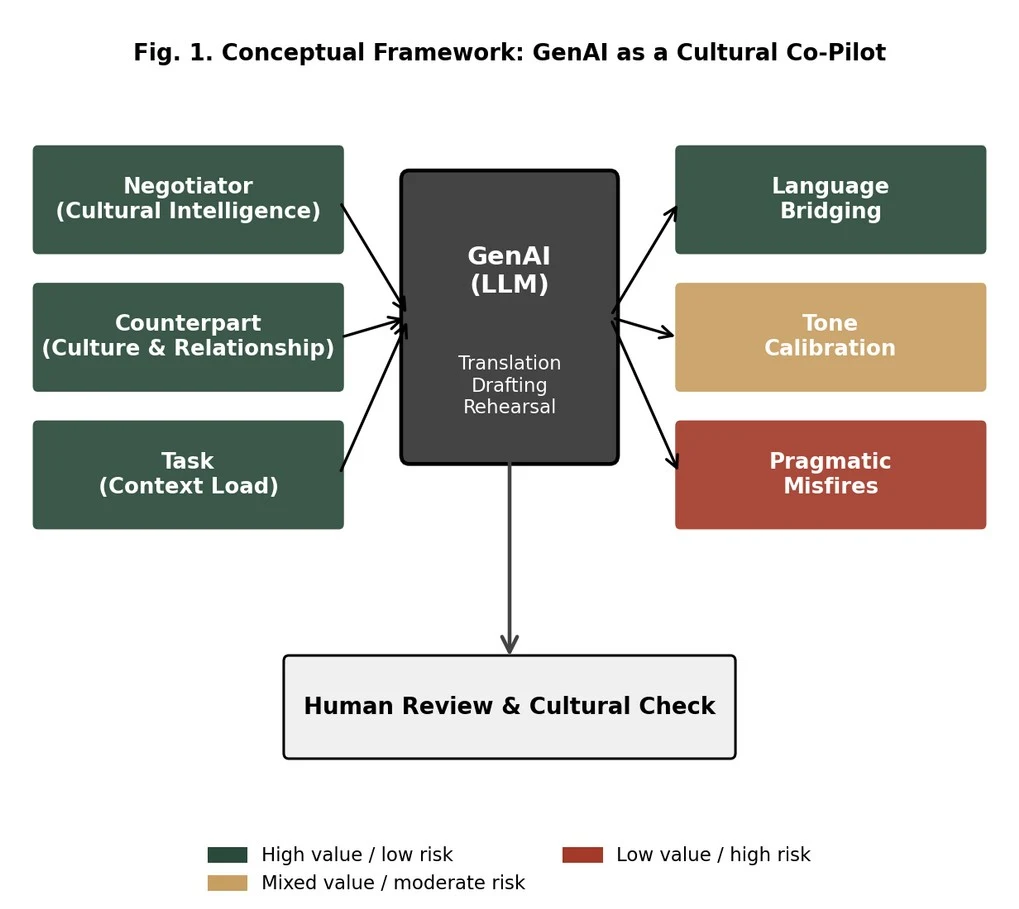
The most useful finding of the review is that “does AI help?” is the wrong question. A better one is: how much of the meaning in this task lives outside the words? We call this the context load of a task. Low context-load tasks, such as translating a technical specification, are mostly about accuracy. High context-load tasks, such as refusing an offer without damaging a relationship, depend on things the AI cannot see: the history between the parties, the status of each person, and what is left unsaid. Fig. 1 presents the conceptual framework that visualizes how negotiator, counterpart, and task feed into the GenAI engine and produce outputs of varying value and risk.
| Task | Context Load | AI Value | Main Risk |
|---|---|---|---|
| Translate specs, terms, schedules | Low | High | Technical mistranslation |
| Summarize long documents | Low | High | Missed nuance |
| Cultural briefing | Medium | Med-High | Stereotyping, generic advice |
| Draft first-contact emails | Medium | Med-High | Wrong formality level |
| Role-play rehearsal | Medium | Medium | Western counterpart |
| Make counteroffer / refuse | High | Low-Med | Directness mismatch, lost face |
| Repair trust after dispute | Very High | Low | Hollow apology |
| Read silence, hesitation | Very High | Very Low | Tool cannot perceive signal |
B. Where AI Genuinely Helps
Bridging language gaps is the clearest win. For many mid-sized firms, AI has made fluent multilingual communication affordable for the first time; a small exporter can now send a well-written proposal in the buyer’s language without hiring a translator for every message. This lowers the barrier to entry and reduces the status gap between native and non-native English speakers, consistent with Noy and Zhang’s [16] finding that AI helps weaker writers most. Preparation is the second clear win: negotiators can use AI to build a briefing on a counterpart’s likely expectations, to list questions to ask, and to rehearse. Used as a starting point rather than an authority, this raises the baseline of preparation, especially for people with little international experience.
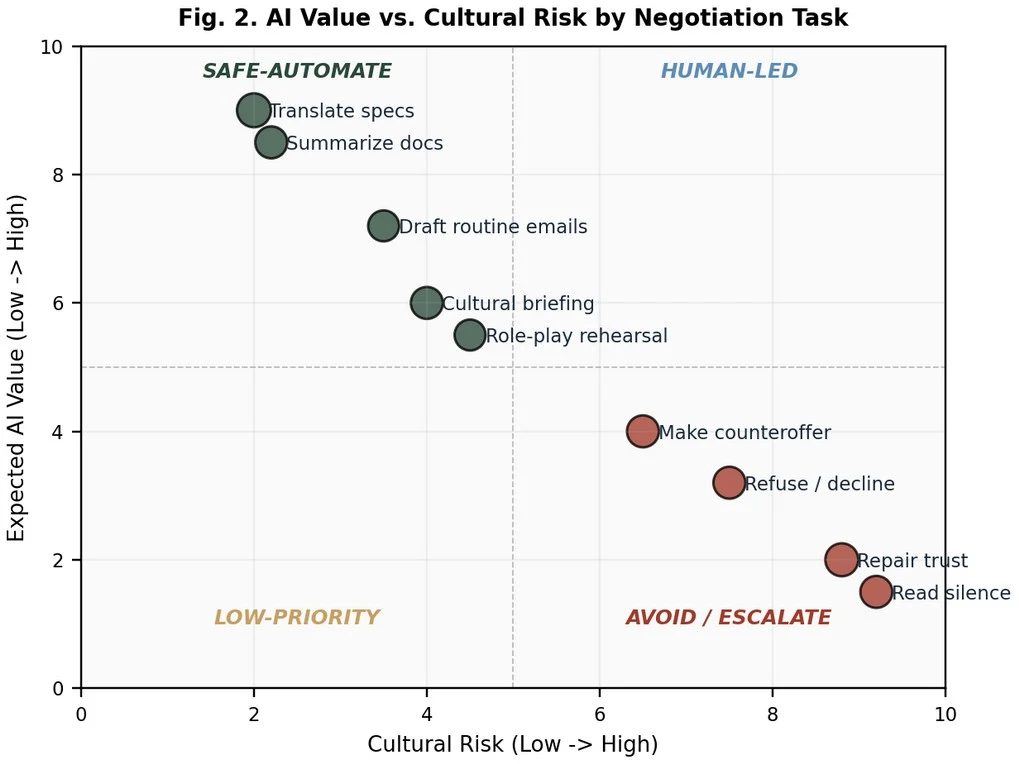
Tone calibration is the third genuine benefit: a manager can ask for the same message in a more formal, softer, or more direct version and compare them side by side. Seeing the options is itself a cultural-awareness exercise. Fig. 2 maps the same tasks onto a value-versus-risk quadrant, making the safe-automate, human-led, low-priority, and avoid-escalate zones visible at a glance.
C. Where AI Quietly Causes Harm
Default cultural lens is the most pervasive harm. Since models lean toward the values of the cultures that dominate their training data [15], an AI-written message will often sound like a polished, direct, low-context business email—suitable for some counterparts and offensive to others. The danger is that the output looks professional, so the user does not question it. Stereotype by summary is the second harm: when asked “how do I negotiate with the Chinese?”, a model returns a confident average, but real counterparts are individuals shaped by region, industry, age, and company. Cultural generalizations are useful as hypotheses and harmful as conclusions.
Pragmatic errors hidden by fluency are the third harm: a grammatically perfect sentence can still carry the wrong level of politeness, an unintended commitment, or an accidental refusal. Because the surface is clean, the error is harder to spot than a clumsy human mistake—this is the jagged frontier at work [17]. Loss of the human signal is the fourth: counterparts often judge trustworthiness from small signs of effort (a greeting in their language, a carefully chosen phrase). If a message is clearly machine-polished, the effort signal can turn into a suspicion signal. Confidentiality is the fifth: pasting draft terms or pricing into a public AI tool can expose sensitive information, a risk many firms underestimate.
D. Cultural Dimensions and AI Capability
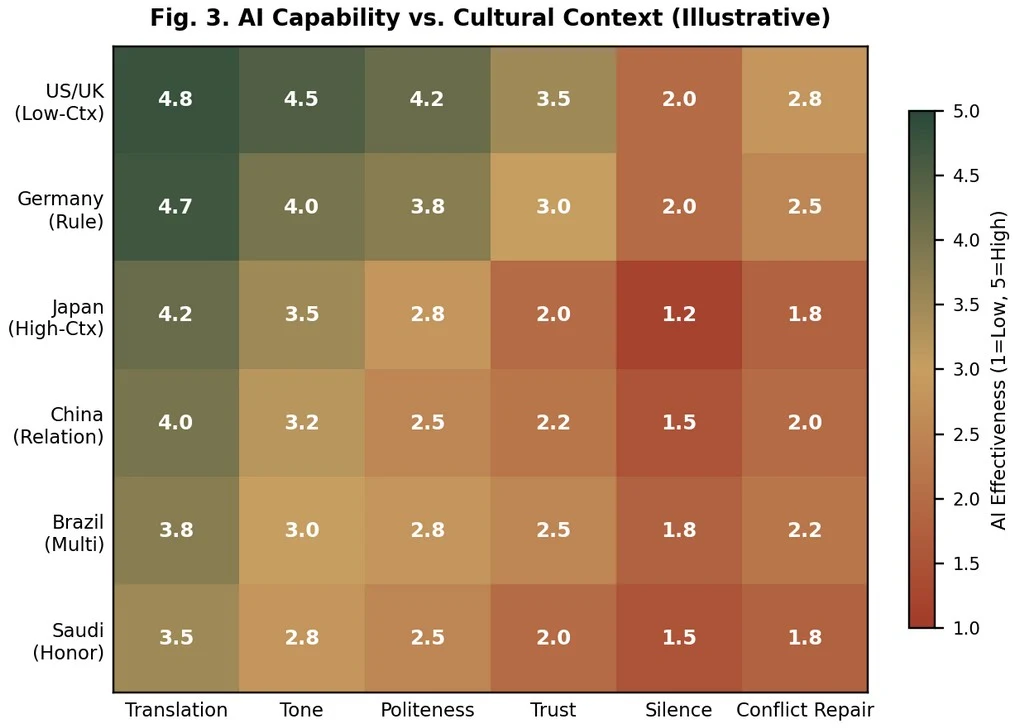
Fig. 3 maps six illustrative cultural clusters against six AI capabilities. The values are theoretical predictions derived from the review, not empirical measurements; their purpose is to make the framework operational and to identify where future empirical work should focus. The pattern is consistent with Tao et al. [15]: AI effectiveness is highest in low-context, rule-based cultures and degrades sharply in high-context and honor-based settings, particularly on capabilities that require reading silence or repairing conflict.
E. Propositions
From this analysis we derive six propositions for future testing. They are stated in falsifiable form so that subsequent empirical work can either confirm, refine, or reject them.
| # | Proposition | Moderator | Test Design |
|---|---|---|---|
| P1 | AI assistance improves effectiveness more for low context-load tasks than for high. | Context load | Within-subject experiment |
| P2 | Translation benefit greater when negotiator has lower language proficiency. | Language proficiency | Mixed design, between-subjects |
| P3 | AI messages perceived as more appropriate by low-context counterparts unless given explicit cultural context. | Context × prompt richness | Cross-cultural experiment |
| P4 | Negotiators with higher CQ obtain more benefit from AI. | Cultural intelligence | CQ pre-test + AI task |
| P5 | Disclosed, human-reviewed AI use preserves trust better than undisclosed use in relationship-oriented cultures. | Disclosure × relationship | 2×2 factorial design |
| P6 | Over-reliance on AI reduces negotiator’s own cultural learning over time. | AI reliance intensity | Longitudinal study |
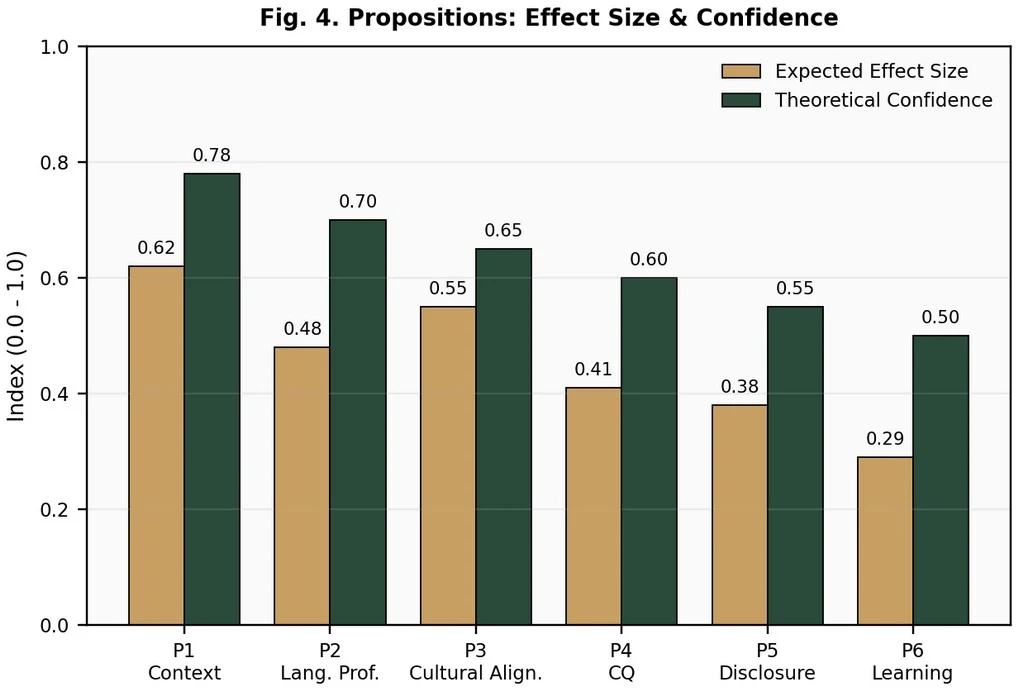
Fig. 4 visualizes the expected effect size and theoretical confidence for each proposition. P1 and P3 are the highest-priority candidates for early empirical work because they have the largest expected effect sizes and the strongest theoretical foundation. P6 is the most consequential for long-term workforce policy but requires a longitudinal design and is therefore the slowest to test.
VII. Discussion
The findings point to one central idea: generative AI changes the cost of communication more than the quality of cross-cultural understanding. It makes it cheap to produce fluent text in any language; it does not make it cheap to know what that text will mean to the person reading it. As fluency becomes universal, fluency stops being a signal—in the past, a well-written letter in the counterpart’s language showed effort and respect, but now it may show only that the sender had access to a tool. What will keep mattering is what AI cannot easily supply: genuine relationship, consistent behavior over time, and the judgment to know when a standard answer is the wrong one.
The findings also reframe the debate about whether technology will replace interpreters and cultural advisers. For routine, low-context work, that demand will shrink, and rightly so. For the delicate moments—a failing negotiation, a loss-of-face situation, a high-stakes first meeting—skilled human mediators become more valuable, not less, because the cost of an invisible AI error is higher. If AI handles the mechanics of language, the scarce skill becomes the ability to evaluate AI output, and that ability is built through experience, curiosity, and exposure, not through prompts. Firms that treat AI as a shortcut around cultural learning may find their people less capable over time, not more.
VIII. Managerial and Business Implications
The framework translates into seven practical guidelines for managers responsible for international deals, designed to be implementable inside existing compliance and procurement policy without requiring a separate AI governance function.
| # | Guideline | Operational Implication |
|---|---|---|
| 1 | Sort tasks before adopting tools. | Let AI handle translation, summaries, routine drafts; keep refusals, counteroffers, apologies, relationship-building in human hands. |
| 2 | Give the AI the context it lacks. | State counterpart’s culture, relationship history, formality level, and goal in the prompt. Output quality improves noticeably. |
| 3 | Always add a human cultural check. | For important messages, have a native speaker or experienced local colleague read the final version. |
| 4 | Treat cultural briefings as hypotheses. | Use AI-generated briefings to generate questions, then verify with people who know the counterpart. |
| 5 | Decide on disclosure. | Set clear company position on when AI use is mentioned, calibrated to market norms. |
| 6 | Protect sensitive data. | Use enterprise tools with proper data agreements; never paste confidential terms into consumer chatbots. |
| 7 | Keep investing in people. | Fund cultural intelligence training and international exposure alongside AI tools. |
IX. Challenges and Limitations
This paper has limits. First, it contains no primary data—the framework is built from existing literature and reasoned scenarios, and the propositions are untested. Second, the technology is fast-moving: models improve every few months, some weaknesses described here may shrink, and new ones may appear; our conclusions are tied to the state of the technology at the time of writing and should be revisited annually. Third, culture is not a country—using national or cluster-level descriptions risks the same stereotyping that we warn against, since individual, organizational, and industry differences are large and frequently dominate national-level effects.
Fourth, language coverage in the underlying research is uneven, and measurement of “communication effectiveness” (combining clarity, trust, respect, and outcome) is difficult, with weights that vary between cultures. Finally, there is a publication lag: because the field is moving quickly, relevant recent studies may have appeared that are not captured here. These limitations are characteristic of conceptual reviews in fast-moving fields, but they should temper the strength with which the propositions are read.
X. Future Scope
Several research directions follow directly from the propositions. Controlled experiments can pair negotiators from different culture clusters and measure joint outcomes, perceived trust, and satisfaction (tests P1, P3). Field studies can follow real firms using AI in international sales or procurement over time. Disclosure studies can test how counterparts react when AI use is revealed (tests P5). Moderator analyses can examine whether cultural intelligence, language proficiency, and negotiation experience change how much people benefit from AI (tests P2, P4). Longitudinal skill research can study whether heavy AI use weakens users’ cultural learning over time (tests P6).
Culturally adapted models—tuned on region-specific business communication—should be evaluated, and benchmarks for pragmatic appropriateness (not only fluency) should be developed. Voice and real-time translation tools deserve dedicated study, as does the ethics of accountability when AI-drafted messages create unintended commitments across legal systems.
XI. Conclusion
Generative AI is already part of international business communication. Our review suggests it is neither the universal translator enthusiasts promise nor the cultural flattener critics fear, but a powerful tool with an uneven profile: strong where meaning is explicit, weak where meaning lives in context, relationship, and silence. The practical lesson is to match the tool to the task—let AI take on language and preparation, while keeping people in charge of the moments where trust is made or lost. The propositions offered here are deliberately falsifiable, so future empirical work can refine, qualify, or reject them.
References
- [1] G. Hofstede, Culture’s Consequences: International Differences in Work-Related Values. Beverly Hills, CA: Sage, 1980.
- [2] G. Hofstede, Culture’s Consequences: Comparing Values, Behaviors, Institutions and Organizations Across Nations, 2nd ed. Thousand Oaks, CA: Sage, 2001.
- [3] R. J. House, P. J. Hanges, M. Javidan, P. W. Dorfman, and V. Gupta, Eds., Culture, Leadership, and Organizations: The GLOBE Study of 62 Societies. Thousand Oaks, CA: Sage, 2004.
- [4] E. T. Hall, Beyond Culture. Garden City, NY: Anchor Press, 1976.
- [5] E. Meyer, The Culture Map: Breaking Through the Invisible Boundaries of Global Business. New York, NY: PublicAffairs, 2014.
- [6] J. M. Brett, Negotiating Globally: How to Negotiate Deals, Resolve Disputes, and Make Decisions Across Cultural Boundaries, 3rd ed. San Francisco, CA: Jossey-Bass, 2014.
- [7] M. J. Gelfand et al., “Differences between tight and loose cultures: A 33-nation study,” Science, vol. 332, no. 6033, pp. 1100–1104, May 2011.
- [8] P. C. Earley and S. Ang, Cultural Intelligence: Individual Interactions Across Cultures. Stanford, CA: Stanford Univ. Press, 2003.
- [9] P. Brown and S. C. Levinson, Politeness: Some Universals in Language Usage. Cambridge, U.K.: Cambridge Univ. Press, 1987.
- [10] R. Fisher and W. Ury, Getting to Yes: Negotiating Agreement Without Giving In. Boston, MA: Houghton Mifflin, 1981.
- [11] L. L. Thompson, The Mind and Heart of the Negotiator, 7th ed. Hoboken, NJ: Pearson, 2020.
- [12] A. Vaswani et al., “Attention is all you need,” in Advances in Neural Information Processing Systems, vol. 30, 2017, pp. 5998–6008.
- [13] T. B. Brown et al., “Language models are few-shot learners,” in Advances in Neural Information Processing Systems, vol. 33, 2020, pp. 1877–1901.
- [14] E. M. Bender, T. Gebru, A. McMillan-Major, and S. Shmitchell, “On the dangers of stochastic parrots: Can language models be too big?” in Proc. 2021 ACM Conf. Fairness, Accountability, Transparency, 2021, pp. 610–623.
- [15] Y. Tao, O. Viberg, R. S. Baker, and R. F. Kizilcec, “Cultural bias and cultural alignment of large language models,” PNAS Nexus, vol. 3, no. 9, pgae346, Sep. 2024.
- [16] S. Noy and W. Zhang, “Experimental evidence on the productivity effects of generative artificial intelligence,” Science, vol. 381, no. 6654, pp. 187–192, Jul. 2023.
- [17] F. Dell’Acqua et al., “Navigating the jagged technological frontier: Field experimental evidence of the effects of AI on knowledge worker productivity and quality,” Harvard Business School, Boston, MA, Working Paper 24-013, 2023.
© 2026 The Author(s). Published by Journal of Computing and Organizational Studies under a Creative Commons Attribution 4.0 International License (CC BY 4.0).